When to use it
Use it for a quarterly or annual capability review, to discuss with the team what to strengthen first, or to support a request for training or hiring budget. The gap between the current and target curves is where the next year's effort should go.
Make it yours
- Replace the dimensions with your team's capability model; a sales team might use prospecting, negotiation and account management.
- Have team members score anonymously and use the average, so it is not one manager's view.
- To compare two squads, rename the two curves to the squad names.
- The count of numbers in braces must equal the number of dimensions.
Mermaid code
team-capability-radar.mmd
radar-beta
    title Engineering team capability
    axis a["Requirements"], b["Engineering"], c["Quality"], d["Delivery"], e["Collaboration"], f["Innovation"]
    curve now["Current"]{3, 4, 2, 3, 4, 2}
    curve goal["One-year target"]{4, 4, 4, 4, 4, 3}
    max 5
    min 0
Ask an AI for one with this structure
Send the prompt below to ChatGPT or Claude, then paste the whole reply into the editor; the code inside is detected automatically.
prompt.txt
Draw a team capability radar chart with Mermaid radar-beta syntax. The title is Engineering team capability, and the axes are Requirements, Engineering, Quality, Delivery, Collaboration and Innovation. Add two curves, Current and One-year target, each with six scores from 0 to 5, plus max 5 and min 0. Output only the mermaid code block.
FAQ
- How do we define the scores?
Write one behavior statement per score, such as 3 for "delivers independently" and 5 for "coaches others and sets the method". With statements, scores from different people can be compared.
- Can there be more than six dimensions?
Yes, though labels crowd beyond eight. Merge similar ones or use two charts.
- Is there a template for individuals?
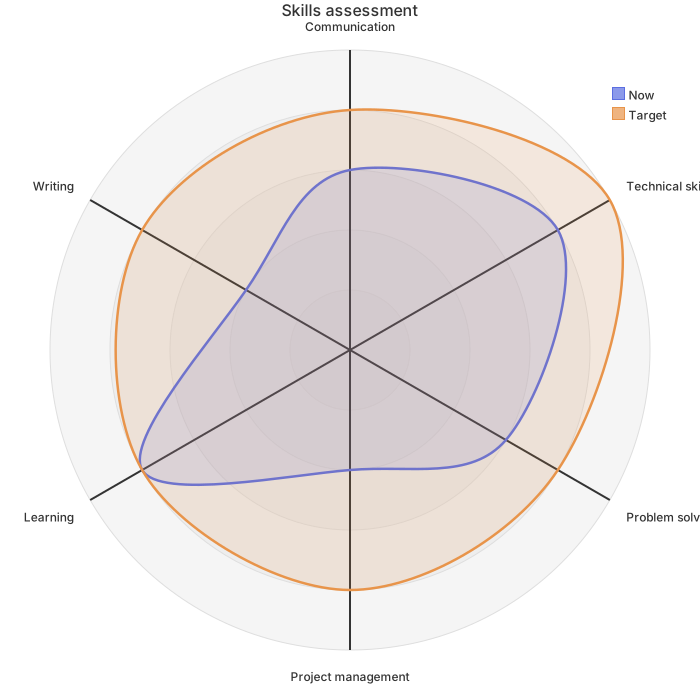
Yes. The skills assessment radar chart in the library suits one-to-one reviews.
More in this category
Updated 2026-11-11